Sunday, May 29, 2011
Kansas Kayaking: Rural Excursions!
If you're itching to get outside and enjoy the loveliness of summer in Kansas, check out Rural Excursions. The trip I wrote about below was one of many taken by Barb last summer to find the best kayaking spots to take people for fun and relaxing excursions. She's got an armada of kayaks ready. Give her a call!


Friday, June 25, 2010
Kansas: Boldly go where no tourist has gone before
“Well, I’d guess this trip probably doesn’t measure up much to all your other travels,” noted Doni, a tough Kansas farmer in her mid-seventies after we finished a day of kayaking on Cedar Creek in Chase County.
“No, that’s not it at all! I always say the best way of killing happiness is comparing it to something else. If you spend time thinking about whether what you’re doing is better or worse than what you’ve done before, then you’ll just sit around trying to figure out if you’re having a good time, rather than just having it.”
I’ve traveled to a lot of different places. I’ve had some amazing adventures. But wouldn’t it be awful if excitement and adventures just made you bored with the rest of life? What a terrible curse! If you find yourself looking at the Rockies and thinking, “They really aren’t as beautiful as the Himalayas,” you better stop and check yourself, because you may be jaded. And that is a sad fate.
In honor of this idea, I’ve decided to revive this neglected blog to muse about traveling in Kansas.


We were late to the old cabin where the neighbor finally found us because we had hit quite a ridiculous logjam across the creek. The logjam blocked the entire creek and was about 30 feet long and 10 feet tall. It took us nearly an hour to figure out how to portage over it. Drew and I carried the four kayaks over the logjam and the kayaks and my legs earned a few new scrapes and scratches.

“No, that’s not it at all! I always say the best way of killing happiness is comparing it to something else. If you spend time thinking about whether what you’re doing is better or worse than what you’ve done before, then you’ll just sit around trying to figure out if you’re having a good time, rather than just having it.”
I’ve traveled to a lot of different places. I’ve had some amazing adventures. But wouldn’t it be awful if excitement and adventures just made you bored with the rest of life? What a terrible curse! If you find yourself looking at the Rockies and thinking, “They really aren’t as beautiful as the Himalayas,” you better stop and check yourself, because you may be jaded. And that is a sad fate.
In honor of this idea, I’ve decided to revive this neglected blog to muse about traveling in Kansas.
I decided to spend my summer back in Kansas after nearly three years on the east coast. I managed to fall in love with a Kansas boy and closing the 1445 mile gap between us has been the best decision I’ve made in a long while.
Drew was raised in Burns, KS, a town of about 200 people about 50 miles northwest of Wichita. This weekend we visited his mom and went kayaking and camping on her friend's land.
Pulling into Burns, we were welcomed by a painted rooster standing proudly on a pile of limestone. “Burns! A Town to Crow About.” (Just one of the many ideas set into motion by Barb Anderson, Drew’s mom.)
The town is the definition of Kansas-quaint with the small water tower with “Burns” painted on the side, the rural volunteer fire department in small metal building with a handpainted sign, the Café in the one-crossroads-downtown, and the houses in town on large plots with small gardens and machinery in the yards.
Everyone knows everyone in this town and everyone waves as you drive past. The waving, even when both parties are driving in cars, seems to break through the anonymity that vehicles normally give people in the suburbs or the city. In most places, the minute you get inside your car, you see others as “cars” not “people.” Drivers regularly engage in behavior that would be considered outrageously rude if it were between two “people” instead of two “cars.” I wonder if there is a lot less road rage where drivers wave to one another as they pass. It all seems much more human out here.
***
We packed up the kayaks at Doni’s farm and headed down the river. We stopped at Doni’s neighbors’ where we left the truck. I went to go pick up some forgotten water bottles and the neighbor saw me walking up the road from the river and came outside to talk. And talk did he. He told me all about his recent trip to Alaska in detail from the times they landed in the small planes that took them out to the most remote locations to the number of hours driven between each city. He was so friendly and easy that you would think he’d known me all my life even though we just met as I walked onto his property for the first time. He ended up doing us the favor of driving the truck down the river to a take out point and spent at least an hour and a half looking around for us. When they finally found us, they weren’t the least bit bothered even though, in some parts of this country anyway, such an imposition would have been met with some major irritation. Either they have a lot more time or a lot more kindness. I think probably both.
Drew was raised in Burns, KS, a town of about 200 people about 50 miles northwest of Wichita. This weekend we visited his mom and went kayaking and camping on her friend's land.
Pulling into Burns, we were welcomed by a painted rooster standing proudly on a pile of limestone. “Burns! A Town to Crow About.” (Just one of the many ideas set into motion by Barb Anderson, Drew’s mom.)
The town is the definition of Kansas-quaint with the small water tower with “Burns” painted on the side, the rural volunteer fire department in small metal building with a handpainted sign, the Café in the one-crossroads-downtown, and the houses in town on large plots with small gardens and machinery in the yards.
Everyone knows everyone in this town and everyone waves as you drive past. The waving, even when both parties are driving in cars, seems to break through the anonymity that vehicles normally give people in the suburbs or the city. In most places, the minute you get inside your car, you see others as “cars” not “people.” Drivers regularly engage in behavior that would be considered outrageously rude if it were between two “people” instead of two “cars.” I wonder if there is a lot less road rage where drivers wave to one another as they pass. It all seems much more human out here.
***
We packed up the kayaks at Doni’s farm and headed down the river. We stopped at Doni’s neighbors’ where we left the truck. I went to go pick up some forgotten water bottles and the neighbor saw me walking up the road from the river and came outside to talk. And talk did he. He told me all about his recent trip to Alaska in detail from the times they landed in the small planes that took them out to the most remote locations to the number of hours driven between each city. He was so friendly and easy that you would think he’d known me all my life even though we just met as I walked onto his property for the first time. He ended up doing us the favor of driving the truck down the river to a take out point and spent at least an hour and a half looking around for us. When they finally found us, they weren’t the least bit bothered even though, in some parts of this country anyway, such an imposition would have been met with some major irritation. Either they have a lot more time or a lot more kindness. I think probably both.
We were late to the old cabin where the neighbor finally found us because we had hit quite a ridiculous logjam across the creek. The logjam blocked the entire creek and was about 30 feet long and 10 feet tall. It took us nearly an hour to figure out how to portage over it. Drew and I carried the four kayaks over the logjam and the kayaks and my legs earned a few new scrapes and scratches.
The creek was beautiful. Peaceful. Surrounded by huge oaks and sycamores with their impressive roots exposed in the midst of a very slow fall into the creek. I like to think of how when you find yourself falling, time seems to stop and you try to grasp for anything around but fighting the inertia is futile. Those trees must feel like that, but they experience that helpless vertigo for years. I can imagine them yelling “whooooaaaahh…” but it is so slow that we mistake it for the wind.
We came upon refrigerators and water heaters and corrugated metal left in very odd positions. Doni pointed out that the tornado that came through a few years back picked up all these things and left them behind on the creek banks. And floods carried other strange items along. There is something satisfying about knowing that it is nature messing with humans and leaving a trail of human made debris behind instead of careless humans dumping their unwanted things in a creek without regard for its beauty.
***
Back at camp, under two gorgeous oaks, Barb cooked up some tasty dinner on the fire. I managed to stay politely unoffensive even as Doni and I talked politics. In a rare show of deference, I let her do most of the talking and I didn’t launch into a single tirade even though we didn’t exactly see eye to eye. But her philosophy towards nature was something I could appreciate. The way she lives her life is something I find immensely valuable and maybe even a far better method than my own that I’ve developed so far.
After dinner, Barb and Drew played guitars and sang songs, many of which they wrote. It was lovely to see the similarities between mother and son, especially with a boy I am so fond of.
Late that night, Drew and I took a walk to see the stars and the equally impressive array of lightening bugs. We had eyed a field full of rows of round bales on the way in. We jumped on top of them and hopped from one to another. Giggling and jumping around on such a phenomenal playground under the stars was just about the best game we could have asked for.
It was a wonderful weekend topped off with my first geocaching search at an artesian well and then getting lost in the lovely dirt roads with farm fields for miles. Drew and Barb taught me a lot about the names and functions of different crops and machinery. I felt like a city slicker trying to become a legit Kansan.
***
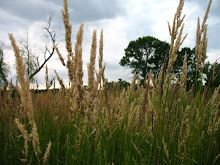
I’m thrilled to be in Kansas for the whole summer. This feels like home. The beauty of flat or rolling farm fields or prairie is far more soothing to me than even the waves of an ocean or the peaks and valleys of a mountain range. It is the everyday beauty that doesn’t scream its own virtues, demanding awestruck admiration. It simply goes about its way and if you have the eye for it, it slowly and modestly reveals its steadfast and deeply rooted strength and beauty. Kind of like some Kansans I know…
***
Back at camp, under two gorgeous oaks, Barb cooked up some tasty dinner on the fire. I managed to stay politely unoffensive even as Doni and I talked politics. In a rare show of deference, I let her do most of the talking and I didn’t launch into a single tirade even though we didn’t exactly see eye to eye. But her philosophy towards nature was something I could appreciate. The way she lives her life is something I find immensely valuable and maybe even a far better method than my own that I’ve developed so far.
After dinner, Barb and Drew played guitars and sang songs, many of which they wrote. It was lovely to see the similarities between mother and son, especially with a boy I am so fond of.
Late that night, Drew and I took a walk to see the stars and the equally impressive array of lightening bugs. We had eyed a field full of rows of round bales on the way in. We jumped on top of them and hopped from one to another. Giggling and jumping around on such a phenomenal playground under the stars was just about the best game we could have asked for.
It was a wonderful weekend topped off with my first geocaching search at an artesian well and then getting lost in the lovely dirt roads with farm fields for miles. Drew and Barb taught me a lot about the names and functions of different crops and machinery. I felt like a city slicker trying to become a legit Kansan.
***
I’m thrilled to be in Kansas for the whole summer. This feels like home. The beauty of flat or rolling farm fields or prairie is far more soothing to me than even the waves of an ocean or the peaks and valleys of a mountain range. It is the everyday beauty that doesn’t scream its own virtues, demanding awestruck admiration. It simply goes about its way and if you have the eye for it, it slowly and modestly reveals its steadfast and deeply rooted strength and beauty. Kind of like some Kansans I know…
Wednesday, February 18, 2009
More Coverage of the WSF
I meant to post this link weeks ago, and now, as a good blogger, my friend has moved forward, piling other relevant stories onto his blog.
You should check those out. But if you're interested in seeing more about the forum, dig back a few weeks and he has some great commentary, photos, and video.
envirobeat.com
You should check those out. But if you're interested in seeing more about the forum, dig back a few weeks and he has some great commentary, photos, and video.
envirobeat.com
Monday, February 16, 2009
Climate Justice Movement
At the forum, I focused on an issue dear to my heart: climate change policy. There was a group of people promoting "Climate Justice." I was surprised to hear that this group was vehemently opposed to the Kyoto Protocol and other such market-based policies. I suppose I'm a bit out of touch with the lefties up here in my ivory tower.
They do make some valid points. Yet, the complete dismissal of carbon trading and any economic solution is, perhaps, going too far. I'd be more forgiving of their dismissal if they proposed viable alternative solutions. But the focus was on tearing down the system with little discussion on what would be put in its place.
Here is my response to the Durban Declaration on Carbon Trading: http://www.carbontradewatch.org/durban/durbandec.html.
On the point of the distribution of carbon permits, I couldn't agree with them more. Giving out permits for free is like giving away free money to companies that have polluted the most. Auctioning permits is far more equitable and generates revenues which can be used for the public good (reduce taxes, pay for healthcare, R&D for clean energy). If you are selling rights to a public good (the atmosphere), shouldn't the public get the revenues? This comes back to the polluter pays principle, which I firmly stand by.
For CDM, additionality is very difficult to prove. When I asked a few different developers of projects receiving CDM credits in India whether the projects would have been pursued without CDM credits, they seemed to be almost surprised at the naivety of such a question. Their stance was that, yes, the CDM is nice, but this project would have happened either way. This has been a widespread criticism. Yet that does not mean that all projects are "hot air." Not to mention that even if the projects are not "additional," it still amounts to a money transfer from the global north to the global south. Especially since most of the projects have been initiated from within the country, not by foreign developers. There may still be cases of some local people losing out with these projects, but I have not been convinced that these projects have had a net negative impact on the communities around them.
So yes, you are likely to lose some of the reduction that would have otherwise occurred when you allow CDM offsets. Yet, there are potential benefits generated as well, such as increased clean infrastructure, efficiency investments, and wealth transfer. Plus, while all of these certified emissions credits are not likely additional emissions reductions, some of them are. So the emissions reductions are not all lost.
As for the commodification of carbon, it is hard to sympathize with this argument. Environmental economists generally support "commodification" as an solution to the tragedy of the commons. People have very negative emotional reactions against the idea of making a natural resource or a public good a "commodity." But with the exception of the issue of pricing the poor out of access to resources, this argument does not seem to have much of an empirical basis for rejection. There are mountains of research that show these methods are unbelievably effective. I understand that people don't like the idea of putting a price on nature, but that appears to be the most effective way of saving it from destruction. I feel that continued survival of a fishery or the stabilization of our climate trumps the discomfort people may feel about a certain concept.
A lot of the problems that Climate Justice raises about carbon markets are answered by carbon taxes. I brought this up at the World Social Forum and the response was generally, "Yes, carbon taxes are better than carbon trading, but they still will not get us where we need to go because they work within the capitalist system."
So for some, it boils down to the fact that nothing but the overthrow of capitalism will save the planet. I am not saying that this is wrong. I am not saying that it is right. I just think that we need a plan B just in case that doesn't pan out.
Diversity in the environmental movement can be a virtue in this way. We don't have to agree on tactics. We should all pursue the methods that we feel will work. Through this diversity of efforts, perhaps one will emerge and generate widespread success or perhaps each will add positive incremental change.
Yet, the venom I found at the World Social Forum against carbon markets seemed a bit over the top. This particular document seems more reasonable, but I feel that they should be better informed on the issues they are discussing. I wonder how many have actually looked at the effectiveness of market policies and environmental taxes. I would be willing to bet that number is very small.
It is amazing that people with such passion on the same issue, and presumably on the same side of the issue (i.e. reduce climate change) can be so out of touch with one another's ideas. We ought to work on that.
They do make some valid points. Yet, the complete dismissal of carbon trading and any economic solution is, perhaps, going too far. I'd be more forgiving of their dismissal if they proposed viable alternative solutions. But the focus was on tearing down the system with little discussion on what would be put in its place.
Here is my response to the Durban Declaration on Carbon Trading: http://www.carbontradewatch.org/durban/durbandec.html.
On the point of the distribution of carbon permits, I couldn't agree with them more. Giving out permits for free is like giving away free money to companies that have polluted the most. Auctioning permits is far more equitable and generates revenues which can be used for the public good (reduce taxes, pay for healthcare, R&D for clean energy). If you are selling rights to a public good (the atmosphere), shouldn't the public get the revenues? This comes back to the polluter pays principle, which I firmly stand by.
For CDM, additionality is very difficult to prove. When I asked a few different developers of projects receiving CDM credits in India whether the projects would have been pursued without CDM credits, they seemed to be almost surprised at the naivety of such a question. Their stance was that, yes, the CDM is nice, but this project would have happened either way. This has been a widespread criticism. Yet that does not mean that all projects are "hot air." Not to mention that even if the projects are not "additional," it still amounts to a money transfer from the global north to the global south. Especially since most of the projects have been initiated from within the country, not by foreign developers. There may still be cases of some local people losing out with these projects, but I have not been convinced that these projects have had a net negative impact on the communities around them.
So yes, you are likely to lose some of the reduction that would have otherwise occurred when you allow CDM offsets. Yet, there are potential benefits generated as well, such as increased clean infrastructure, efficiency investments, and wealth transfer. Plus, while all of these certified emissions credits are not likely additional emissions reductions, some of them are. So the emissions reductions are not all lost.
As for the commodification of carbon, it is hard to sympathize with this argument. Environmental economists generally support "commodification" as an solution to the tragedy of the commons. People have very negative emotional reactions against the idea of making a natural resource or a public good a "commodity." But with the exception of the issue of pricing the poor out of access to resources, this argument does not seem to have much of an empirical basis for rejection. There are mountains of research that show these methods are unbelievably effective. I understand that people don't like the idea of putting a price on nature, but that appears to be the most effective way of saving it from destruction. I feel that continued survival of a fishery or the stabilization of our climate trumps the discomfort people may feel about a certain concept.
A lot of the problems that Climate Justice raises about carbon markets are answered by carbon taxes. I brought this up at the World Social Forum and the response was generally, "Yes, carbon taxes are better than carbon trading, but they still will not get us where we need to go because they work within the capitalist system."
So for some, it boils down to the fact that nothing but the overthrow of capitalism will save the planet. I am not saying that this is wrong. I am not saying that it is right. I just think that we need a plan B just in case that doesn't pan out.
Diversity in the environmental movement can be a virtue in this way. We don't have to agree on tactics. We should all pursue the methods that we feel will work. Through this diversity of efforts, perhaps one will emerge and generate widespread success or perhaps each will add positive incremental change.
Yet, the venom I found at the World Social Forum against carbon markets seemed a bit over the top. This particular document seems more reasonable, but I feel that they should be better informed on the issues they are discussing. I wonder how many have actually looked at the effectiveness of market policies and environmental taxes. I would be willing to bet that number is very small.
It is amazing that people with such passion on the same issue, and presumably on the same side of the issue (i.e. reduce climate change) can be so out of touch with one another's ideas. We ought to work on that.
Saturday, January 31, 2009
World Social Forum - REDD
1.28.2009
Belem, Brazil – Day 5
Today was my first full day at the World Social Forum and I must say that little of what I have found has surprised me. All of the frustrations I was expecting, I have found. All of the interesting perspectives I was expecting, I have found. Yet this is not meant as a critique or to imply that I have not learned a great deal. The people here have given me important new perspectives—some of which may change the way I approach these topics in my future work.
When each person tells their story, it brings these issues to life. Even as I read about the impacts of climate change or globalization on the lives of indigenous people or poor communities, I tend to think, “Yes, I know it is terrible. Let’s move on to the solutions.” But then I forget what I am fighting for. I get caught up in the “wonkery” of policy and economics. Once I am enveloped in these details, I don’t think about how these macro solutions affect people’s lives on the ground.
For instance, it never dawned on me that REDD (Reducing Emissions from Deforestation and Degradation—a policy to sell carbon credits from intact forests) would have significant negative impacts on people without legal rights to their land. Large landowners who have titles to the land that indigenous and local people use could sell the carbon rights to the global market. Then these “squatters” would be banned from practicing the “slash-and-burn” agriculture that they have been doing sustainably for thousands of years. Without this source of food, they go from being self-sufficient and culturally intact to being impoverished and dependent.
Now, the real problem here is land rights, not forest carbon policy. But without addressing the land rights issue, adding the forest carbon policy exacerbates the consequences of the problem.
One issue that was even more puzzling to my economist-mind was that they sited increasing the economic value of the forests was a major problem. I thought this was the point. You make a standing forest more valuable than a deforested forest. Then people will keep the forests intact because it’s profitable to do so. But these critics of REDD did not see it that way. They felt that the land grab by the rich and the pricing out of the poor that could result from REDD was unacceptable.
While these are very valid issues, I feel that these critics who venomously oppose market-based policies like REDD are being somewhat disingenuous in their motives. They were self-righteous about their love of trees and the UN/REDD proponents love of money, yet they oppose these policies not because they would not promote forest conservation but because they exacerbate land ownerships problems. They create a false choice between land rights and REDD. The real choice is between making it profitable to cut down forests or making it profitable to conserve forests. How is preventing REDD going to address land ownership? It won’t. How is preventing REDD going to affect deforestation? It will allow the status quo to continue.
From the meeting, I took away three major lessons specific to REDD policy.
1)We should change the UN’s definition of “forest” to exclude tree plantations.
2)We need to explicitly recognize the rights of indigenous people to their land.
3)We need to put resources—especially legal and technical expertise—into place to help small landowners take advantage of the program.
***
Belem, Brazil – Day 5
Today was my first full day at the World Social Forum and I must say that little of what I have found has surprised me. All of the frustrations I was expecting, I have found. All of the interesting perspectives I was expecting, I have found. Yet this is not meant as a critique or to imply that I have not learned a great deal. The people here have given me important new perspectives—some of which may change the way I approach these topics in my future work.
When each person tells their story, it brings these issues to life. Even as I read about the impacts of climate change or globalization on the lives of indigenous people or poor communities, I tend to think, “Yes, I know it is terrible. Let’s move on to the solutions.” But then I forget what I am fighting for. I get caught up in the “wonkery” of policy and economics. Once I am enveloped in these details, I don’t think about how these macro solutions affect people’s lives on the ground.
For instance, it never dawned on me that REDD (Reducing Emissions from Deforestation and Degradation—a policy to sell carbon credits from intact forests) would have significant negative impacts on people without legal rights to their land. Large landowners who have titles to the land that indigenous and local people use could sell the carbon rights to the global market. Then these “squatters” would be banned from practicing the “slash-and-burn” agriculture that they have been doing sustainably for thousands of years. Without this source of food, they go from being self-sufficient and culturally intact to being impoverished and dependent.
Now, the real problem here is land rights, not forest carbon policy. But without addressing the land rights issue, adding the forest carbon policy exacerbates the consequences of the problem.
One issue that was even more puzzling to my economist-mind was that they sited increasing the economic value of the forests was a major problem. I thought this was the point. You make a standing forest more valuable than a deforested forest. Then people will keep the forests intact because it’s profitable to do so. But these critics of REDD did not see it that way. They felt that the land grab by the rich and the pricing out of the poor that could result from REDD was unacceptable.
While these are very valid issues, I feel that these critics who venomously oppose market-based policies like REDD are being somewhat disingenuous in their motives. They were self-righteous about their love of trees and the UN/REDD proponents love of money, yet they oppose these policies not because they would not promote forest conservation but because they exacerbate land ownerships problems. They create a false choice between land rights and REDD. The real choice is between making it profitable to cut down forests or making it profitable to conserve forests. How is preventing REDD going to address land ownership? It won’t. How is preventing REDD going to affect deforestation? It will allow the status quo to continue.
From the meeting, I took away three major lessons specific to REDD policy.
1)We should change the UN’s definition of “forest” to exclude tree plantations.
2)We need to explicitly recognize the rights of indigenous people to their land.
3)We need to put resources—especially legal and technical expertise—into place to help small landowners take advantage of the program.
***
27 Hours on a Tropical Island
Days 3 & 4 were spent on an island in the river delta. It was amazing. We spent the evening around a fire on the beach with a group of Brazilians. When we were tired from the effort of communication, we walked and watched a thunderstorm off in the distance. There were white sand beaches where, instead of seashells, we collected amazing seeds that float down from the Amazon forests. Half of the island shore is beach, half mangroves. We found gorgeous, completely deserted beaches and enjoyed the sun just a little too much—we’ve been suffering ever since.
And the quote of the trip: “We are becoming less dysfunctional by the day. We are exponentially emerging from our dysfunction.” –Laura-Alex Frye-Levine
And now, onto the Forum…
***
And the quote of the trip: “We are becoming less dysfunctional by the day. We are exponentially emerging from our dysfunction.” –Laura-Alex Frye-Levine
And now, onto the Forum…
***
Friday, January 30, 2009
First days in Brazil
My apologies not posting sooner. This is the first time I've been able to get wifi and my usb drive died. But my current wifi location/situaion is somewhat hilarious. There is a DJ pumping what I would call "organic-hindi-techno" music about 15ft away. I hear a drum circle not so far away. The forum is over for the day and now the parties begin. I'm trying to do my homework... Seriously. But the internet is hopelessly slow. I'm giving up. Time to go explore and find a samba circle.
1.24.09
Belem, Brazil
So we really should have brought a phrasebook… I really should have listened more closely to my Portuguese lessons from my roommates. I really should learned something more than please and thank you.
Laura-Alex and I are staying in a home out in the suburbs of Belem with lovely people who have had few interactions with foreigners. Over breakfast, communication was nearly hopeless between our sleep deprived minds and general confusion of finding ourselves on a different continent. Then naptime. Over lunch, things improved, especially with the discovery of a yellowed and well-worn English-Portuguese dictionary. Then more naptime.
I woke up at 10pm and was a bit disappointed that I spent my first day in Brazil in bed, so I went for a walk with another guest who speaks both English and Portuguese! Hurrah, I found my savior-translator. We ended up ‘going out’ with three girls who live here and communicating was both the chore and the entertainment for the evening. (Pantomimes and learning each other’s cuss words and favorite insults…) Saturday night in the suburbs of Belem reminds me a bit of the Saturday nights in the suburbs of Kansas City. Drive around in a car full of girls, stop here and there. Get hit on by guys in cars.
Tomorrow will be more eventful…
1.25.2009
Belem, Brazil Day 2
We just got a lecture from a worried mother hen waiting up for her chickies to come home. In Portuguese. But oh yes, I understood.
We were so worried (hand over heart)! We drove around and looked for you. What happened? Why didn’t you call? Are you hungry? We were so worried!
Her daughter stood by and interjected, Mom, stop, they don’t even understand Portuguese! She gave us a sympathetic glance.
We gave lame-ass excuses about missing the bus.
I feel terrible that we had kept up this very nice family waiting for us, worrying. Yet, I found it a bit hysterical that the “we were up worried sick” lecture is so universal that we needed no translator to catch every sentiment. Besides, it was only 11pm.
Today, we registered at the conference and purchased passes to camp nearby. The place already has the feeling of a music festival (but somewhat more chaotic and disorganized…).
****
Much has happened since, I believe we're on day 6... The forum has been fascinating and eye-opening and fun. I'll try to get another post up soon...
1.24.09
Belem, Brazil
So we really should have brought a phrasebook… I really should have listened more closely to my Portuguese lessons from my roommates. I really should learned something more than please and thank you.
Laura-Alex and I are staying in a home out in the suburbs of Belem with lovely people who have had few interactions with foreigners. Over breakfast, communication was nearly hopeless between our sleep deprived minds and general confusion of finding ourselves on a different continent. Then naptime. Over lunch, things improved, especially with the discovery of a yellowed and well-worn English-Portuguese dictionary. Then more naptime.
I woke up at 10pm and was a bit disappointed that I spent my first day in Brazil in bed, so I went for a walk with another guest who speaks both English and Portuguese! Hurrah, I found my savior-translator. We ended up ‘going out’ with three girls who live here and communicating was both the chore and the entertainment for the evening. (Pantomimes and learning each other’s cuss words and favorite insults…) Saturday night in the suburbs of Belem reminds me a bit of the Saturday nights in the suburbs of Kansas City. Drive around in a car full of girls, stop here and there. Get hit on by guys in cars.
Tomorrow will be more eventful…
1.25.2009
Belem, Brazil Day 2
We just got a lecture from a worried mother hen waiting up for her chickies to come home. In Portuguese. But oh yes, I understood.
We were so worried (hand over heart)! We drove around and looked for you. What happened? Why didn’t you call? Are you hungry? We were so worried!
Her daughter stood by and interjected, Mom, stop, they don’t even understand Portuguese! She gave us a sympathetic glance.
We gave lame-ass excuses about missing the bus.
I feel terrible that we had kept up this very nice family waiting for us, worrying. Yet, I found it a bit hysterical that the “we were up worried sick” lecture is so universal that we needed no translator to catch every sentiment. Besides, it was only 11pm.
Today, we registered at the conference and purchased passes to camp nearby. The place already has the feeling of a music festival (but somewhat more chaotic and disorganized…).
****
Much has happened since, I believe we're on day 6... The forum has been fascinating and eye-opening and fun. I'll try to get another post up soon...
Subscribe to:
Posts (Atom)

 Posts
Posts

